
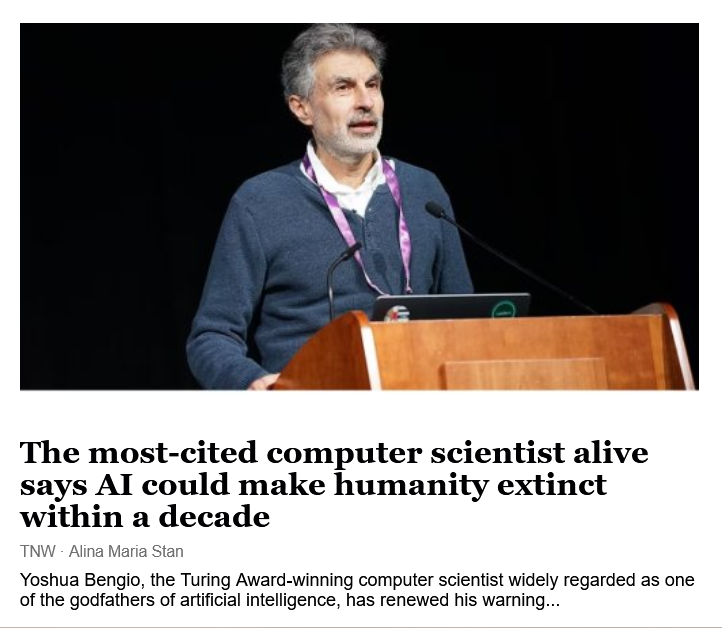
On an almost daily basis, maybe even multiple times per day basis, I am confronted by some news story announcing the end of the world via AI. Look at the accompanying headline, ostensibly by a great mind in Info Tech, if you think I am exaggerating.
The whole issue is artificial but not intelligent, which is also true of AI itself. There is nothing “intelligent” about AI.
Before I say anything else, I should establish some bona fides, after all, why should any of my readers imagine that I know enough about the topic to comment? So here that goes. Oracle’s first commercial database product was its version 3.0, which, to the best of my knowledge, was never used to create a commercial database or product. I began using Oracle with its version 4, and while most of my friends know me as a scholar of biblical Hebrew, I actually earned my living as a database engineer. By the time of my retirement from the University of Michigan, I had created databases and managed entire departments at UM’s College of Engineering. While I was no “coding genius,” I knew the trade reasonably well, and had enough knowledge of the industry to be an effective manager.
The use of the term “Artificial Intelligence” or “AI” is sheer marketing genius. It seeks to present what is actually a normal and ordinary expansion of existing products as something new and revolutionary. But it is neither. It’s just more of the same. And when I say that, I mean the “same” as hysterical reactions to every other minor milestone in Info Tech history.
Today’s audience has largely forgotten that once upon a time someone invented a device called the “slide rule.” This was a physical tool with engraved numbers and a slide that allowed it to be used to make all sorts of calculations more readily than with pencil and paper. The pundits of the time announced Armageddon and the downfall of pencils. A few years later, portable calculators arrived and, Oh My God, children will never learn how to do simple arithmetic.
The world inched further towards global destruction with the arrival of personal computers. And don’t get me started on Word Processors and <gasp> spell checkers. No one will ever be able to spell again! Actually, in the case of the stupidity of the English language, that wouldn’t be such a bad outcome!
I hope you get the idea. All of these various technological advances were accompanied by announcements of the number of jobs they were going to destroy. And the truth was (and is), if a job can be eliminated this way, there wasn’t much reason for that job to exist.
The good news is that even though AI is currently being hyped at a ridiculous level, it is a worthwhile development in the IT sphere and has the potential for doing much good in our lives and the world. It may very well replace the need for humans in some jobs, but in hindsight, I’m pretty sure we’ll wind up agreeing that those humans have found much better things to do with their lives.
While we’re all waiting for AI to rise to the promise, we’ll also be seeing it misused and we’ll have to work towards mitigating those aspects. I don’t know about you, but I’m pretty tired of arguing with an AI bot about whether I need to speak to a human customer service representative. And using AI for deceptive purposes in reels and other digital media has already reached absurd levels. Hopefully, as we learn to dismiss those reels and such without giving them credence or even looking at them, the volume will decrease.
But while that is going on, AI can take my older, faded and decrepit photos and help me restore them so that I can remember how wonderful my loved ones were decades ago. So, the answer is to use AI for what it is good for and learn to avoid it when it is used for ill purposes.
Climbing down from my soapbox now!

11 Responses
Meir, once again, your comment points to real problems and issues. But there is a “so what” there. It turned out to be very true that automobiles put horse-drawn cabbies out of business. Who knows if those folks who were very good at managing their horses could find comparable work? But is the solution to that problem curtailing or banning automobiles?
I wish I could share your optimism but I’ve got to look several moves down the line on these patterns I see. The intelligence, the automations, the robotics… they are only going to get better and better.
There will never be enough “new jobs” for the people laid off to go get. That’s a nice fairy-tale to pacify the people from what’s going on here.
Another thing that I am seeing happen which doesn’t get reported on from this angle: employers are choosing AI over humans even when the output is just “good enough” because they are wanting to cut expenses.
There’s no question that AI will replace lots of tech industry jobs. The question, IMO, is whether those jobs are (please excuse the expression) mindless. And the corollary is whether those displace will find other perhaps more satisfying employment.
Hi Jack. I hope you’re right though recent large scale tech layoffs do seem to result from AI.
Yeah…. we need a global agreement to not build ASI similar to the nuclear agreements. Show me one example of a smarter intelligence species being controlled by a lower intelligence species…
It isn’t that I think you’re wrong, Meir, but I think along with many other very intelligent observers you are not perceiving how ordinary these developments are. Let me try to explain it better. In the 1930s, scientists came to the realization that nuclear processes could be weaponized, and indeed it was the USA that first not only completed that scientific exploration, but actually detonated weapons that completely destroyed two cities. Today, we have weapons that are easily one hundred times that powerful. But of course, we have also harvested that energy to power cities and allow ships to run for decades without refueling. For over two centuries, we have developed the scientific knowledge to treat pathogens and cure diseases that were once relentless in killing millions of people, but we also have within our national laboratories pathogens which could wipe out a major part of the Earth’s human population.
There is nothing new about that fact that any scientific development can cut more than one way. The question isn’t about “alien” intelligence. It is about whether *human* intelligence will learn to use the advancements for the betterment of humanity or otherwise.
That’s why I’m saying that there is no reason for hysteria here. There is every reason for concern.
Alien means a non-biological intelligence that we don’t understand how it works. All the people arguing online who don’t even work in that tech like to be confident that it is “just math” or “just predicting the next token”, but I keep hearing the researchers saying how none of the labs truly understand what’s going on beyond the base substrate. End of humanity is only one potential future. There is always “bad people doing bad things”. But also I like to point out that it is not a secret that all these labs are very clear that they intend to develop the tech to replace all human workforce. What are we supposed to think when the people building it are admitting these things?
We have to remember, you can’t use today’s versions of AI and robotics as the benchmark. This is the worst versions we will have. They are only going to improve.
But hey, I hope I’m wrong.
I appreciate your contribution! I’ve been following it as you have and reading many of the same things. I don’t know what an “alien intelligence” is, but whatever it is, they’re not building it. All AI is more of the same. So I guess we’ll just have to see which one of us is right!
Jack,
I’ve been following this for over a year. Using the tech. Building with the tech. Watching interviews of many experts in the field like Geoffrey Hinton, Roman Yampolskiy, Tristan Harris. They’ve been trying to wake us all up for a while now. The TV news finally is starting to cover some of it.
The same parts of AI that could bring us very positive benefits are the same that could bring very negative benefits.
As of yet, none of the companies have a plan on how to guarantee control over the Artificial Super Intelligence that they are racing to build.
This is not the same as past inventions in history. This time it’s not better tools humans are building. They are birthing an alien intelligence.
As far as I know Bernie Sanders is the only politician trying to take action on this.
First, thanks so much for participating on my blog! Your question is, I hope you’ll forgive me for saying so, in the genre of “How many times a day do you beat your spouse?” You are providing a litany of sins that have been laid at the feet of organizations promoting AI, but it’s a one-sided list, isn’t it? These companies do, in fact, also employ huge numbers of people and provide services that you and others will be purchasing, otherwise their capital outlays make no sense. It is up to those of us who live in potentially affected locations to do what we can to protect ourselves against bad actors in this regard. So I might very well join you in opposing huge data centers in our area, or requiring them to mitigate any environmental consequences, and requiring utilities to ensure delivery of their products to consumers. It is the same sort of tug-of-war we have with any other industry–for example, requiring paper manufacturers to replace the forests they might cut down. But we don’t outlaw the production of paper, do we?
But are you going so far as to defend gigantic data centers that use huge amounts and water and electricity, often causing residential utility rates to increase, potentially harm the environment, and provide few — if any — local jobs after construction is finished?