
Note: this article contains Hebrew characters. If you are reading this via email and want to view the Hebrew, you should use the link at the end of the article to read it online. The email processing program replaces foreign characters with question marks (???).
For a couple of days, I’ve been musing about the notion of “correct” English and I’ve been a little surprised that some of the negative reaction I’ve received has been from friends who I think are not really understanding my point—even though I tried to be at pains to state it. I am not criticizing people who strive to use a more formal dialect of English than the common vernacular. In fact, my entire point is about reducing the amount of criticism for anyone’s language choices. I thought that should be obvious from the fact that I personally do strive to use more formal English than most. When I lecture and when I write, whether it’s for a scholarly journal or for social media, I am using what might be described as professional or academic English. From time to time, I do like to slip in some of the vernacular of my original Bronx homeland or my current place in the foothills of the Appalachians, but hopefully it is always clear that that these sorts of comments are in the spirit of camaraderie.
Perhaps my point would be clearer if I spoke a little about the history of the current Israeli Hebrew language, which is, after all, my specialty.
Many of my readers have no doubt heard some stories about the origins of Israeli Hebrew, it can be quite the long story, so I’ll try to be succinct. At the end of the nineteenth century, no form of Hebrew was a native spoken language. Every form of Hebrew, biblical, rabbinic, medieval and modern (literary) was learned as a secondary language by people who natively spoke a variety of languages in the lands of their birth such as Russian, Ukrainian, German, Spanish, English and Arabic. Perhaps the largest population of Jews at that time used Yiddish as their primary language. And even though Yiddish is written in Hebrew letters, it is actually a form of German.
Eliezer ben Yehuda famously forced his child Ehud to speak Hebrew before any other language, which made Ehud the first native speaker of Hebrew in the modern era. It gives me pause to realize that when I studied at Hebrew University in 1977, Ehud was still very much alive and living down the street from me!
The group around Eliezer who fostered the modern Hebrew language had some decisions to make, not least of which was the pronunciation of Hebrew they would favor for their project. At that time (ca. 1900), the majority of Jews pronounced Hebrew with a strong, German or Slavic-leaning accent, a pronunciation system called “Ashkenazic”. But those Jews living in a newly reviving Jewish homeland in Palestine were often culturally biased against the Jews of eastern Europe who were still living in “Golus” (“Exile”). Therefore, they looked to another widely used version of Hebrew pronunciation, that of the Spanish-speaking Jews. These Jews were known by the Hebrew term for Spain, Sfarad. One distinct advantage of Sfardic is that it utilizes just five simple vowels (“a” as in “father”, “e” as in “bed”, “I” as in “machine”, “o” as in “hole” and “u” as in “rule”) making it easier for new students to learn it. The Ashkenazi dialect has about twice that many vowel combinations. Both dialects add dipthongs (such as “ay” and “oy”).
One problem faced by anyone learning a language is that it is difficult to adopt a pronunciation that is different from the sounds available in one’s native language, so the Hebrew preferred by the new speakers from Ashkenaz did not quite sound like the Sfardi dialect. I refer to it in jest as “Ashkesfard.”
A third major pronunciation system for Hebrew was largely ignored by the early generations of modern Hebrew speakers, that of the inhabitants of Arabic-speaking countries. These are now generally grouped as “Eidot haMizrah” (“populations of the East”). The key aspect of these speakers’ pronunciation is that Arabic, unlike Spanish and German, is a Semitic language and preserves the Semitic phonemes which were lost to the European speakers. Two of these phonemes are critical: the ח (het) which has a rasping “h” sound, very distinct from כ (kaf, which without a diacritical mark called dagesh sounds like the “ch” in German as in nacht). Second, the ע (‘ayin), which has a powerful sound produced by vibrating the vocal chords which is very difficult for European language speakers to emulate. Arabic actually has three levels of the ‘ayin. When the ancient Greeks heard the people of Aza pronounce the name of their town, they wrote it down as Gaza, and the cloth produced in Aza, they called “gauze.” As far as we can determine, Hebrew throughout its history maintained just one of those sounds, but it is distinct from aleph and readily identifiable.
Having noted all this about Arabic, I should also note that it would also be a mistake to imagine that Arabic is always a good guide to Hebrew pronunciation. In fact, most Arabic dialects lack at least two phonemes found in Hebrew—the “p” sound of פּ (peh) and the “g” sound of ג (gimel). One example to illustrate—there is a town in the Golan called “Banias” by its Arabic speaking population, but the town was founded by Greeks who called it “Paneas,” named for the Greek god Pan. Because Arabic lacked the ability to render “P,” it became “Banias.”
Now why is all this so important? Let’s consider one example faced by Jews almost every time we open a prayer book. The almost-official credo of Judaism is the line taken from Deuteronomy 6:4, “Listen, Israel! The LORD is our God, the LORD is one.”
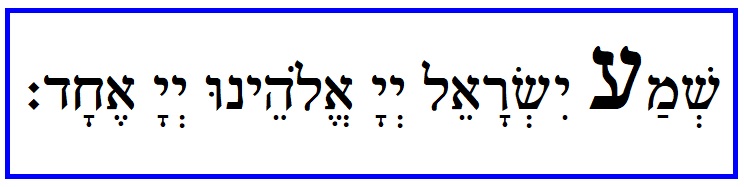
The word for “Listen!” ends with the letter ‘ayin ע. Speakers from Arabic speaking backgrounds pronounce the word properly with a full-throated laryngal sound. But both the Ashkenazi and Sephardi populations are unable to reproduce this phoneme—they allow it to quiesce. In that situation, the sound of the ‘ayin becomes identical to an ‘aleph א. But there actually is a word spelled that way, שמא “shema” which means “perhaps.” It would almost be comical if it weren’t such a serious part of the faith: “Perhaps, Israel, the Lord is our God…” Many Jewish prayer books try to resolve the issue with typography, by printing the ‘ayin large. But no matter how large you print it, if you pronounce it without the laryngal sound, you’re still risking that it be understood as “perhaps.” Without the laryngal, the only phonetic differentiation is the vowel in the first syllable, and the difference between the “shva” and a “seghol” can be subtle. In other words, because of the lack of that ‘ayin phoneme, the common pronunciation of the credo, the Shma, sounds like heresy. Should we say that this pronunciation, favored by a majority of Jews worldwide, is an error?
This series of posts is about the notion that we are better off describing what we find in the manner of speech and writing and refraining to the extent possible from judgmental viewpoints. In Biblical Hebrew, the verb l’kales means “to curse.” But in rabbinic Hebrew, it is used to mean “to beautify,” “to praise.” Linguists believe the reason is the influence of Greek where the word “kalos” means “beautiful.” Should we be critical of the people who apparently did not know of the original meaning of the verb and altered its meaning in such a dramatic way? Should we be critical of introducing non-Hebraic culture into the language? As far as I understand the current state of the art, it is not our duty to either praise or criticize, merely to observe and document.
None of this means that as a teacher I would not correct English grammar in a student’s paper that conflicts with the established norms of academic English, and I would also correct Hebrew which violates the norms of the Hebrew of whatever period might be in play in a student’s work. Part of the duty of a teacher is to help a student understand those norms. But I would temper those corrections with observations about the nature of language, and concede that sometimes we have to recognize that variations will exist, languages will develop, and norms will change.